My Xylotrupes gideon stop eating for 2 days, I am looking for advices of their health issues and how to structure my beetles tank

I have bought a pair of gideon beetles four days ago. On the first day, they keeps eating for the whole day and on the second day, they mate and still eating a whole slice of banana like the picture below.
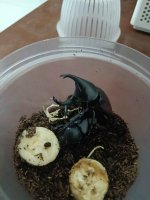
IMG_20251128_061444.jpg
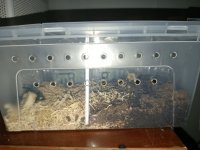
But recently, beetles stop eating for 2 days after their mating, this is my first time having beetles and I am very worry, especially the female beetle keeps hiding and burrowing into the dirt, her body feels so weak and slow, hissing me when I dig her up (sounds like a very weak mouse) and instantly burrowing into the dirt aftedward. Male beetle keeps finding the female one by burrowing himself and my friend said that I should keep the male away, so I split the tank up like the image below, the dirt side is for the female and the saw dust side is for the male.
Untitled46_20251202000121.jpg
The male one is still strong and active, but still not eating like the female.

Sorry for my bad English and I'm looking for everyone advices.
Thanks
 
Seems like normal behavior. You should keep them with more humidity and separate the male from the female. I use damp moss for keeping males. If you want the female to lay eggs, you will need deeper container with proper substrate.

For egg laying you need to set up a breeding box. Drill some airholes, but don't go overboard. You will need a tall/wide container (at least 7-12 inches in height or bigger), organic potting soil or flake soil, some leaves/sphagnum moss on top and beetle jellies. The substrate needs to be damp, but not wet where water is able to be squeezed out of it. When you transport the male and female into the breeding box, you will witness mating at some point. Make sure to provide leaves/sphagnum moss on top as the beetles can flip over. Without something to grab onto on top, they can flip over and pass away. After mating, the female will disappear into the substrate for a few weeks/months. Separate the male back into his original container. Feel free to breed him with the female again when she surfaces to feed. Make sure the substrate maintains the proper moisture level.

After a few weeks/months, the female will disappear and lay eggs. After this timeframe, you will need an unscented heavy duty black garbage bag. Rip the bag open creating a covering for a portion of your floor. Now we need to grab the egg laying container and gently flip it upside down on the garbage bag. The substrate should slide out in the form of the container it was in, almost like when you build a sand castle. From here, gently break off "blocks" of the substrate and separate the eggs. These will look like white airsoft BB's. I will now separate each egg into it's own deli cup container with airholes and substrate.

After a while, larvae will emerge from these eggs. The larvae will poop a lot and leave "frass" in their cups. If there is too much frass in their environment, they will need to be moved to a larger container with a fresh food supply. I keep them on the organic potting soil/flake soil until they are L2, and they need to be rehoused after hitting this stage. After L2, they will need a constant supply of flake soil with proper decay. At L3 they start to get big and will need a bigger container with even more substrate. These larvae get big when fed properly, so having a container large enough for each is essential.

Once the larvae gets to late L3 and turns very yellow, they will finally hit the pupa stage. From here, they will construct a pupal cell, and start their next stage of life. It is important to not bother the beetle in this stage. Make sure the pupal chamber is not collapsed, if it does, you can gently remove the pupa and create an artificial cell out of floral foam. After a while, the beetle emerges. It is not uncommon for them to enclose with a bent horn/elytra not fully shut exposing the wings.
 
Thank you very much for the detailed respond. I don't want my female to lay eggs but they have mated, I just want to see my beetles eat and play with them. So what is the minimum requirement for the beetle tank to keep the female alive and not having any stress? Do I really need a separate tank for the female?
 
Rhino beetle males are usually less dangerous than stags, so I wouldn’t worry. I’ve never kept this species since I am in the U.S., but I have heard they are very easy to care for. Definitely add more substrate and humidity, though. Best of luck with breeding them!
 
That link does not work for me when I click it. What's your goal with keeping this species? They aren't long lived and it would be awesome to get some larvae!
 
My goal of keeping them is to pet and seeing them eating. I don't mind their lifespan, and don't have enough time to take care of the larvae because I have to study abroad in the next 3 months. Btw there are 3 L1 larvae in the dirt I showed in the post, but they looks fine and staying peacefully at the bottom of the tank.
 
She will be fine with the move.
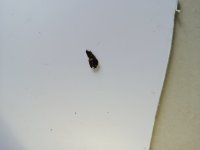
Update: she is very fine and digging really fast into the bottom of her new house after the move. However while moving I have found one of the larva was dead like this. It looks three of my larvae were fine 5 days ago and now I only see the smallest one, 1 missing and 1 died like this. The substrate is still moist enough and the remaining larva looks kinda inactive.
 

Attachments

  • IMG_20251207_114742.jpg
    IMG_20251207_114742.jpg
    278.8 KB · Views: 0
What substrate are you using? Consider separating the larvae into individual raising containers, so the humidity and airflow is easier to maintain and they don’t disturb each other. The L1 phase is the riskiest phase with the most die-off.
 
What substrate are you using? Consider separating the larvae into individual raising containers, so the humidity and airflow is easier to maintain and they don’t disturb each other. The L1 phase is the riskiest phase with the most die-off.
The substrate that the beetle owner sell, it is made of decomposed wood. Btw female is making a really big tunnel and making a lot of digging noises after the move
 
What substrate are you using? Consider separating the larvae into individual raising containers, so the humidity and airflow is easier to maintain and they don’t disturb each other. The L1 phase is the riskiest phase with the most die-off.
Should I disturb the female one more time? She is digging and working very hard
 
Back
Top